
Chernobyl’s steel shell was never meant to protect it from a war
A senior technical adviser on the project Eric Schmieman warns
News
Publish date: 30/04/2026
Written by: Dmitry Gorchakov
News
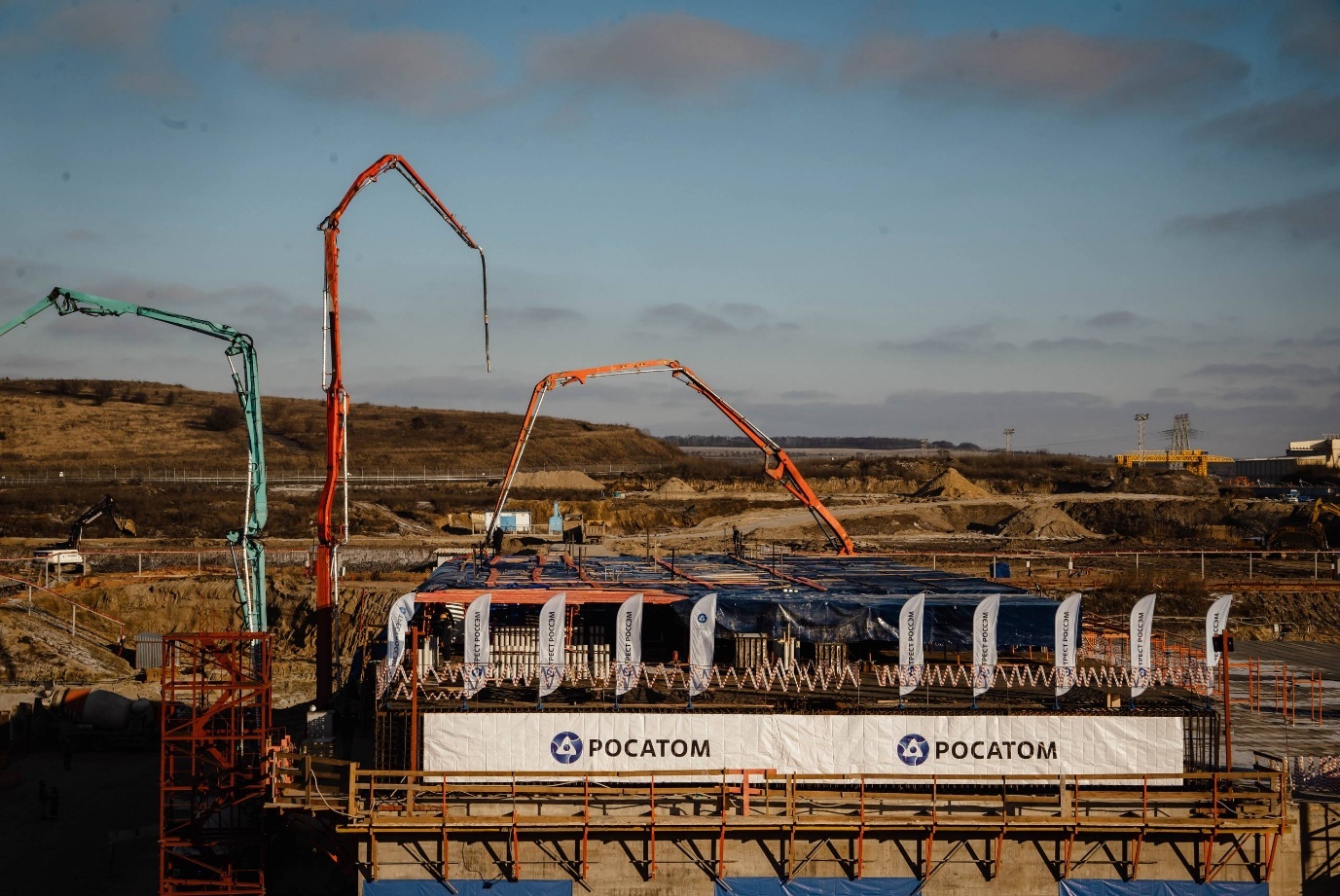
Kursk II is one of Rosatom’s most important nuclear construction projects within Russia. Four of the most advanced and powerful units in Rosatom’s history—VVER-TOI reactors with capacities of up to 1,250 MW each—are being built there.
But this site is also the Russian nuclear power plant closest to the border with Ukraine. Likely for this reason, Rosatom is carrying out construction under conditions of limited transparency—either not publicly disclosing key construction milestones or doing so with significant delays and inconsistencies. This has led to confusion even at the level of the International Atomic Energy Agency (IAEA).
The four new VVER-TOI units at Kursk II are intended to replace the older RBMK reactors at the existing Kursk NPP. Construction of the new plant began in 2018. The first unit of Kursk II was connected to the grid at the end of 2025. The second unit is roughly one year behind the first. Units 3 and 4 are currently in their early stages. However, developments over recent months present a contradictory picture of their status. Specifically, it remains unclear whether construction of Unit 3 has officially begun, and that concreting of the base slab of the reactor building started.
In March 2026, the status of Unit 3 at the Kursk II NPP was updated in the International Atomic Energy Agency’s Power Reactor Information System (PRIS) and in the World Nuclear Association database. According to the new entry, first concrete was poured on January 31, 2026, and the unit was officially classified as under construction. Based on data from the WebArchive service, this update appeared in the PRIS and WNA databases in mid-March.
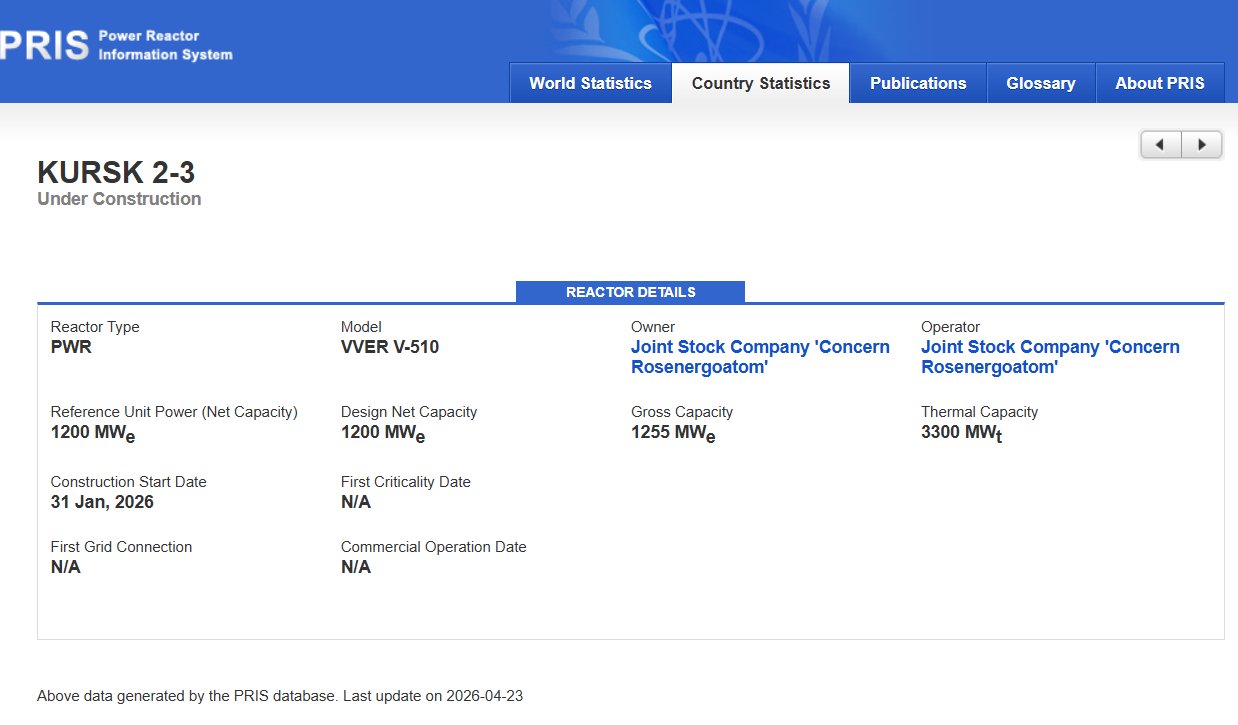
At the same time, there were no public confirmations of construction beginning from Rosatom or its subsidiaries. One of the few reference points was a statement by the plant director in early 2025, indicating plans to begin first concrete pouring by the end of the year.
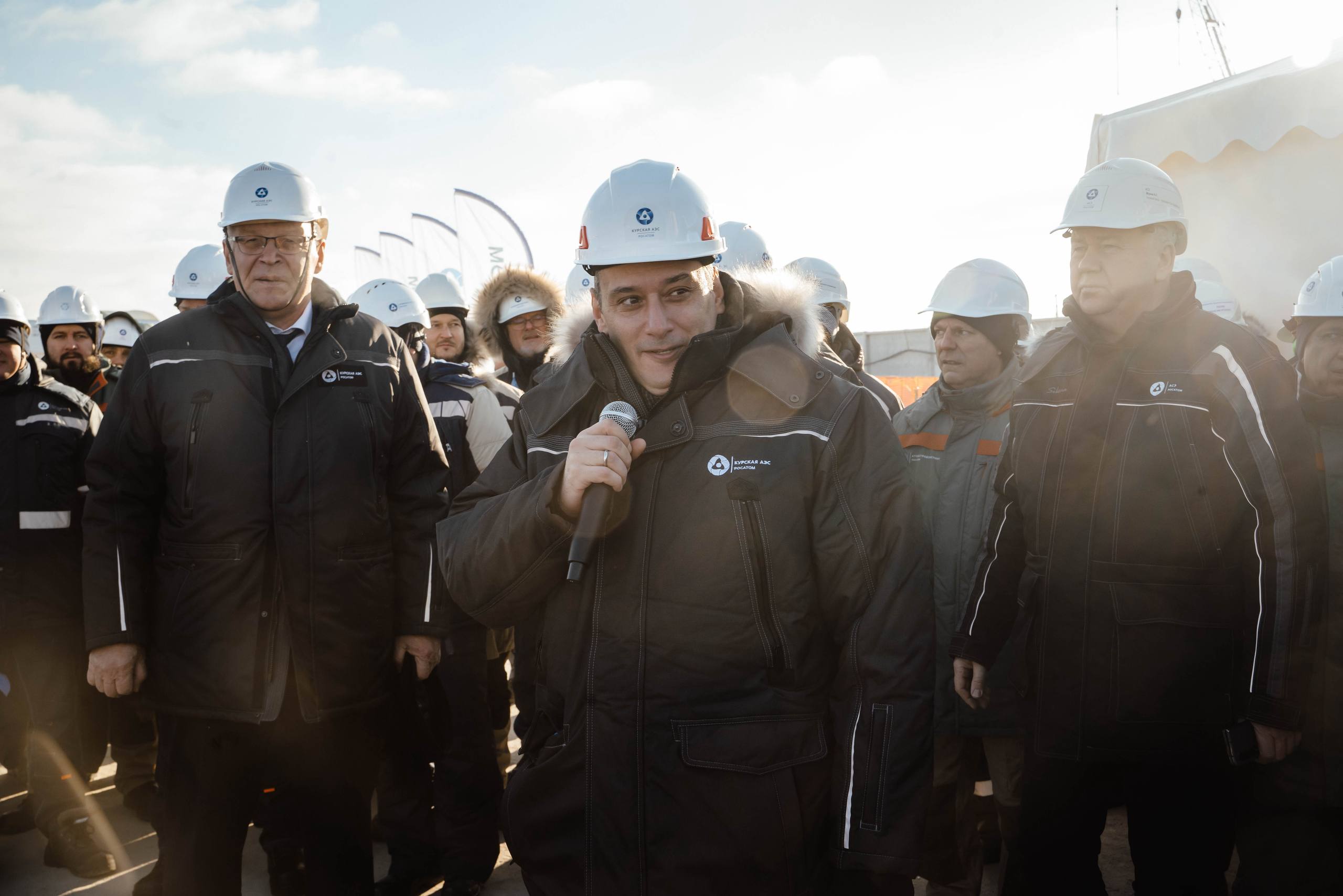
The only Russian source reporting on the start of construction of Unit 3 at Kursk II NPP was by Kursk Region Governor Alexander Khinshtein. On January 29, a post with photos from an official ceremony at the Kursk II construction site was published on his Telegram channel. The text of the post stated, among other things: “You know why these photos from the Kursk II construction site are historic? Because on the day they were taken, the ‘first concrete’ was poured! Together with plant personnel, on the eve of the first unit’s physical start-up, we launched the pouring of the foundation slab for Unit 3 with a ceremonial first concrete event…”
If these statements are to be believed (although any statements by officials in Russia today should be treated with caution) it can be inferred that the first concrete ceremony did not take place on January 29, nor on January,31 as indicated in the PRIS and WNA databases, but no later than December 31, 2025, when Unit 1 of Kursk II NPP was connected to the grid. This is because physical start-up (first criticality) procedures clearly occur before first grid connection.
Moreover, on January 22, Alexander Khinshtein was involved in a serious car accident and remained hospitalized until February. Therefore, he could not have physically attended any ceremony at the end of January.
At the same time, in his post, Khinshtein links the term “physical start-up” to a news item about the unit’s grid connection on December 31, which suggests that he (or his aides and advisors) is simply confusing the concepts of physical start-up and grid connection.
The term “physical start-up” usually refers either to a specific event—the reactor reaching the minimum controlled power level (MCP, or first criticality)—or to the broader phase leading up to it, beginning with the loading of the first fuel assembly into the reactor. According to the PRIS database (as of April 24, 2026), first criticality at Unit 1 of Kursk II NPP took place almost a year earlier, on May 22, 2025. On December 31, the unit achieved first grid connection, when it began supplying electricity to the grid. Thus, the first concrete pouring for Unit 3 could have taken place “on the eve” of the events of December 31.
At the same time, the photos from Khinshtein’s channel clearly show that they were taken in cold weather and clear conditions—most likely in late autumn or early winter. People are wearing warm winter clothing and their breath is visible; the sun is relatively low even during the day. However, there is neither the mud typical of spring nor a stable snow cover (which in Kurchatov formed only after December 27, 2025) visible in the images.
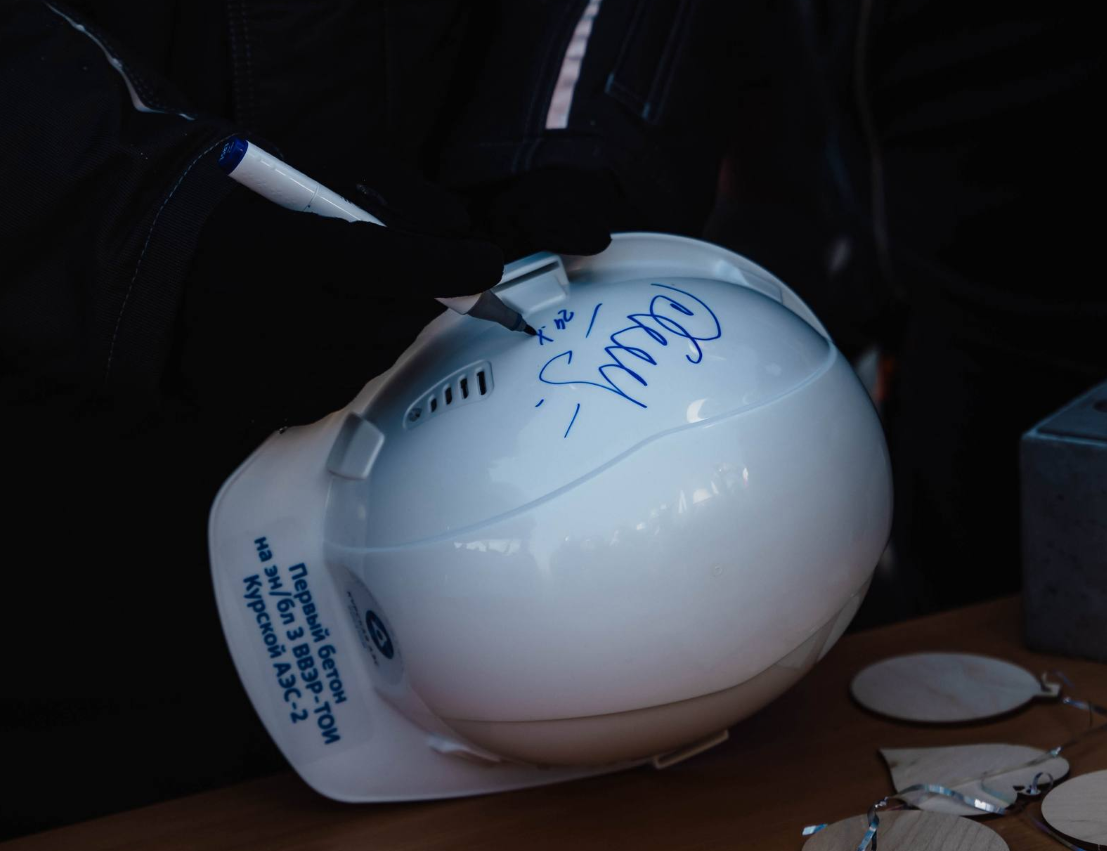
The most important photographic evidence from Khinshtein is one image in the post showing a helmet with the inscription “first concrete at Unit 3, VVER-TOI, Kursk II NPP” (consistent with the traditions of such ceremonies), on which he is signing and has only partially written the date “24.X…”. The Roman numeral “X” could be followed by “I”, “II”, or nothing, corresponding, in European date ordering, to 24 October, 24 November, or 24 December 2025.
An analysis of archived weather observations in the city of Kurchatov shows that the first two dates are unlikely due to relatively warm above-zero temperatures. By contrast, on December 24 it was cold (around –10°C), partly clear, and still without a stable snow cover.
The governor’s schedule indicates that he was on official visits that day. Early in the morning, he attended the opening of a facility just north of Kursk (in the settlement of Kamyshi—around 8–9 a.m., judging by the sun’s position in the photos, which also confirms clear weather). He then opened a center for adaptive sports for people with disabilities in Kursk, including veterans of the war, and could well have proceeded afterward to the Kursk NPP site, where, judging by the photos, he appears to have been around midday.
At the same time, the governor’s visit to the NPP is, of course, not reflected in his official schedule, nor is the event mentioned in the information channels of Rosatom or its subsidiaries.
All of the above leads to the following conclusion: most likely, the first concrete pouring ceremony for Unit 3 of Kursk II NPP did indeed take place on December 24, 2025—not on January 31, as indicated in the PRIS database.
Interestingly, following the update of the PRIS database—although this is most likely unrelated—there was a brief mention of concrete pouring at Unit 3 in materials from Rosatom-affiliated entities. On March 26, the corporation’s machine-building division published a note on its website (only in Russian) about the start of manufacturing the reactor vessel for Unit 3 at the Atommash plant. In the background section of the article, almost in passing, it was noted: “At the Unit 3 site, first concrete for the reactor building was poured in December 2025, and foundation concreting is currently ongoing.” The same material was republished on the Rosenergoatom website on the same day. Thus, without much publicity, information about a key milestone for the operator of Russian NPPs appeared on its website, effectively confirming that it took place on December 24.
Key milestones in nuclear power plant construction—especially the start of construction (first base slab concrete pouring)—are typically marked by formal ceremonies. In the case of Rosatom’s international projects, such events are attended not only by the head of Rosatom, but also by senior officials from both countries, and sometimes even by the heads of state (either in person or, more often, via video link), as well as representatives of the International Atomic Energy Agency. For example, Rafael Grossi attended the first concrete ceremony at Paks II on February 5, 2026. Similarly, Vladimir Putin and the President of Egypt jointly launched such a ceremony at El Dabaa in January 2024.
Sometimes, stages that are less significant from a technical standpoint but important in political and symbolic terms are accompanied by public ceremonies attended by the head of Rosatom and officials from the host country. This was the case, for example, in August last year in Kazakhstan during the start of site survey works, and on April 28 this year during the first fuel loading into the reactor at the Rooppur Nuclear Power Plant in Bangladesh.
Within Russia, in recent years Putin has launched first concrete ceremonies via video link for Unit 3 of Leningrad II NPP in March 2024 and Unit 4 in March 2025. The only major nuclear unit whose official construction start in recent years was not accompanied by prominent media coverage or the involvement of Putin is precisely Unit 3 of Kursk II NPP.
But why? The reason is certainly that Kursk NPP is the Russian nuclear power plant closest to the border with Ukraine. For the past four years, it has effectively been the only Russian nuclear plant located roughly 60 km from the front line. During the Ukrainian counteroffensive in August 2024, the front line moved even closer— to approximately 20 kilometres from the nuclear power plant. At that time, Rosatom actively drew attention to the situation at the plant, highlighting potential risks of drone strikes, partially evacuating personnel from the construction of new units, and securing a visit by the head of the International Atomic Energy Agency. It appears that after this period (and possibly even earlier), a decision was made to scale back public reporting on developments at the site due to security reasons.
Almost all key preparatory stages for the launch of the first unit of the new plant took place under near-total information blackout. Its grid connection on December 31, 2025 was the first milestone to be publicly highlighted by Rosenergoatom and Rosatom. Obviously, an event that is no longer limited to activities at the construction site but involves supplying electricity to the grid is much harder to conceal, and reporting a major achievement by the end of the year was likely necessary. It is possible that subsequent stages after grid connection are considered less vulnerable to external attacks and therefore do not require the same level of information blackout, as any potential incident would no longer relate to construction delays but rather to risks to an operating nuclear power unit.
However, prior to this, Rosatom’s structures did not publicly report on key preceding milestones of the reactor start-up—such as the beginning of the physical start-up phase, fuel loading, or reaching first criticality.
Concurrently, during the period when Unit 1 of Kursk II NPP reportedly reached first criticality in May 2025, Vladimir Putin paid a personal visit to the site. His visit to the Kursk region and the plant on May 21, however, was reported without any reference to these critical construction milestones. But according to PRIS data, the following day—May 22—is listed as the date the unit reached first criticality. In other words, Putin continues to be personally involved in key nuclear construction events, but Rosatom does not publicly acknowledge them and tightly controls all information released regarding construction timelines and milestones.
The fact that this publicly available information is reflected in International Atomic Energy Agency databases only with significant delays—or with distortions—raises additional concerns. The Power Reactor Information System (PRIS) has been developed and maintained by the IAEA for more than 50 years and is compiled on the basis of information provided by national sources. In the case of Russia, this source is most likely Rosatom itself. However, to what extent can these data be subject to any form of external verification?
Over the past four years, Russia and Rosatom have actively sought to bring the IAEA and its Director General to their side in shaping public assessments of events surrounding the Zaporizhzhia NPP. At the same time, Rosatom—responsible for managing the occupied plant—has systematically restricted IAEA staff access to key facilities for evaluation.
Information provided by international organizations, particularly those within the UN system, plays an important role in countering disinformation and manipulation by conflicting parties. During armed conflicts, pressure from major nuclear powers on international organizations—especially the International Atomic Energy Agency—increases significantly, requiring these institutions to demonstrate a high degree of resilience, impartiality, and accuracy in all aspects of their work.
Unfortunately, even the IAEA is not immune to serious basic errors. For example, as of this writing (April 26, 2026), the PRIS database lists the location of the Belarusian NPP—built by Rosatom—as Wenzhou (a city in China), rather than Ostrovets in Belarus.
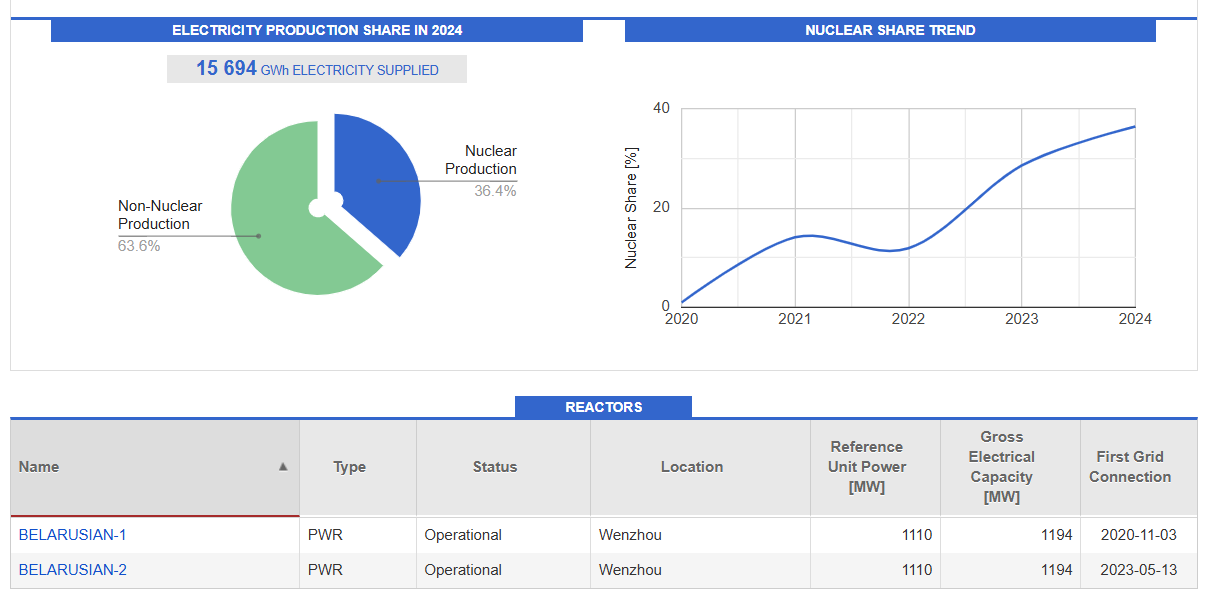
Regardless of the reasons—whether inaccuracies in source data, insufficient verification or correction process, or technical errors—such cases point to the vulnerability of these databases.
Such vulnerability creates a risk that international databases (such as PRIS) and industry databases (such as WNA’s database, which partially rely on PRIS) may become instruments of information manipulation, particularly during armed conflicts. It raises a broader issue: if information about a nuclear unit near a conflict zone can be distorted for security-related reasons, what would prevent similar distortions elsewhere—for example, to present projects as being completed faster than they actually are for competitive advantage?
All of this creates demand for alternative databases with more transparent data disclosure. Examples include the WNISR Interactive Dataviz, as well as the database on Rosatom’s international projects currently being developed by Bellona, so far compiled in report format. Although no database is flawless, the existence of alternative sources and the possibility of cross-checking them is of critical importance for researchers and decision-makers.
The resilience of international nuclear organizations, their credibility, and their ability to address critical challenges during armed conflicts will largely depend on their capacity to ensure data accuracy and to resist potential distortions—whether concerning the occupied Zaporizhzhia NPP or any other civilian nuclear facility.
A senior technical adviser on the project Eric Schmieman warns

UN nuclear watchdog chief Rafael Grossi on Tuesday warned during a visit to Russia's Kursk nuclear plant that its proximity to ongoing fighting was "extremely serious" following Ukraine's cross-border offensive into the southwestern Kursk region earlier this month

It is a scenario the Russian side is taking seriously. Already Rosatom, Russia’s state nuclear corporation, had begun withdrawing staff from the plant and Russian troops are hastily digging trenches around it

As the Ukrainian army’s cross-border incursion into Russia’s Kursk Region rages into its fourth day, the objectives of the surprise attack have been grist for media speculation